Professional vs DIY Carpet Cleaning in Clarksville, TN: What's Worth It
Honest cost math, equipment differences, drying times, and when a rental makes sense versus calling a pro.
Every year, thousands of Clarksville homeowners stand in the hardware store aisle staring at a carpet cleaning rental machine and doing the math: thirty-some dollars for the day versus a couple hundred for a professional. The rental looks like a steal. Sometimes it is. Often, it is not. This guide lays out the honest comparison, machine versus machine, dollar versus dollar, so you can decide which one actually makes sense for your home.
Fair warning: this is not a hit piece on DIY. Rental machines have a legitimate place, and we will tell you exactly where that place is. But the rental-versus-pro decision is not as simple as the price tags suggest, because the two options are not selling the same thing. One sells you an afternoon of effort. The other sells you a result.
The Real Cost Math: DIY vs Professional
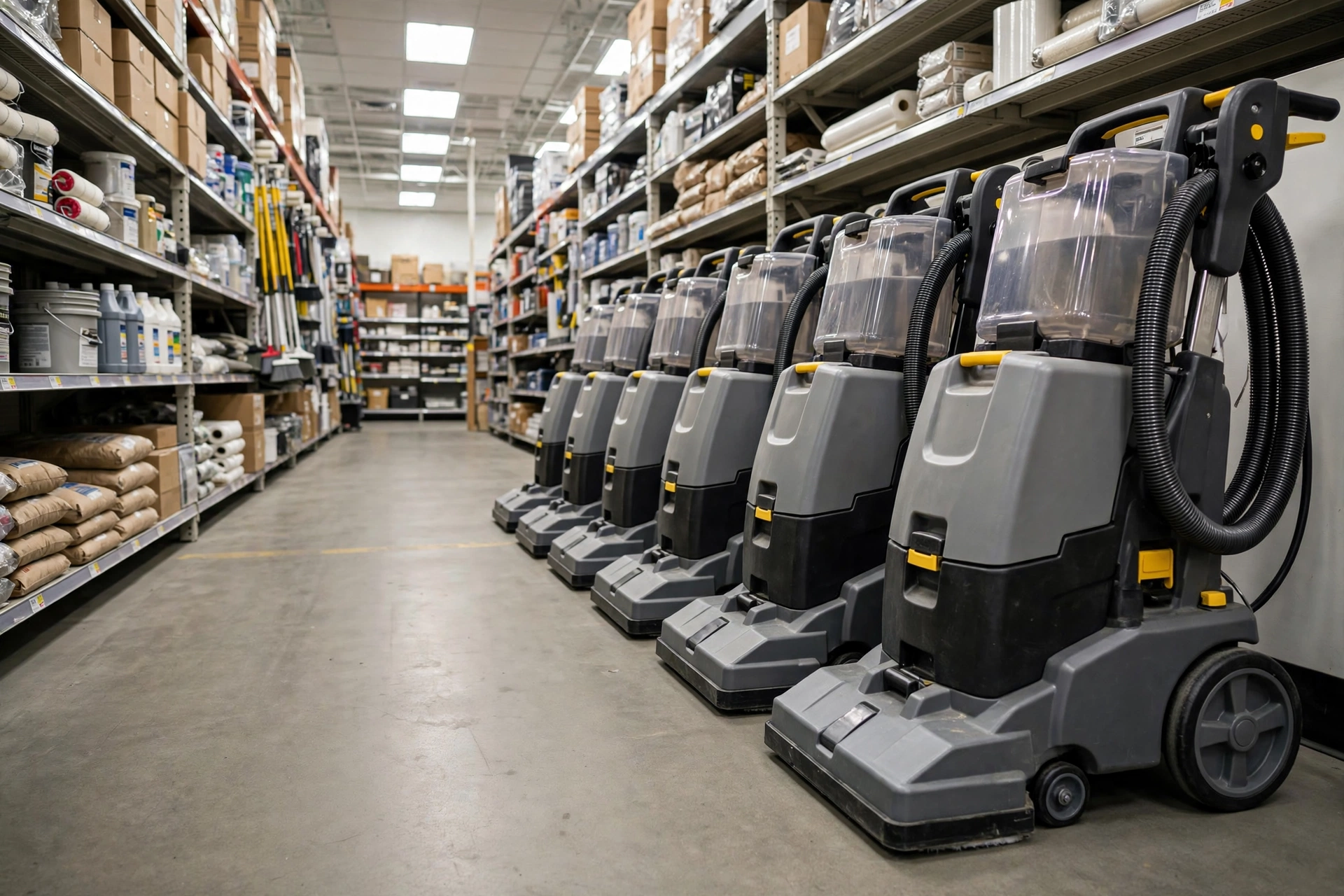
Let us start with the numbers everyone asks about, using published industry figures rather than guesses. Renting a carpet cleaner typically costs $30 to $50 per day for the machine, plus $20 to $40 for cleaning solution, plus another $10 to $30 for spot removers and deodorizers. All in, a DIY day runs $60 to $120 before you count your time (SA Carpet Cleaning, 2026). Other industry estimates put the DIY range at $40 to $90 per rental or $50 to $200 all-in depending on the size of the job (Elite Flooring Services, 2026; Happy Home Helpers, n.d.).
Professional cleaning for a typical home runs $120 to $350 for most houses, or $120 to $400 per session depending on size and condition (Elite Flooring Services, 2026; Happy Home Helpers, n.d.). The national average per visit sits around $182 (Angi, 2026).
So the sticker comparison is roughly $60 to $120 DIY versus $120 to $350 professional. The rental wins on price, clearly. But sticker price is where the simple version ends and the real version begins, because the two options differ in five ways that all cost you something: equipment power, drying time, cleaning chemistry, your labor, and how long the results last.
Equipment: What the Machine Actually Does
A carpet cleaner does two things: it puts water and solution down, and it sucks dirty water back up. The difference between a rental and a professional machine is how well it does the second part.
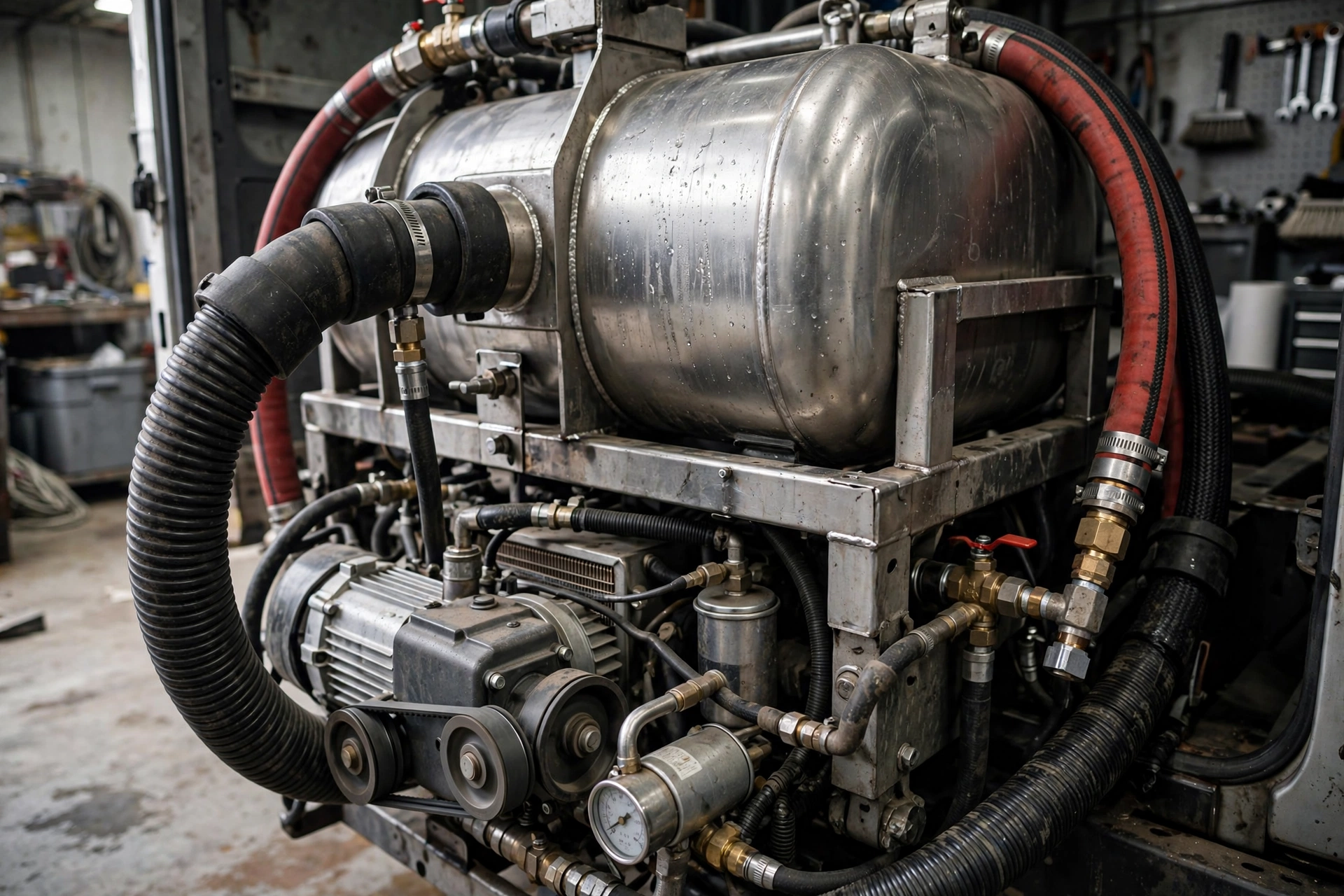
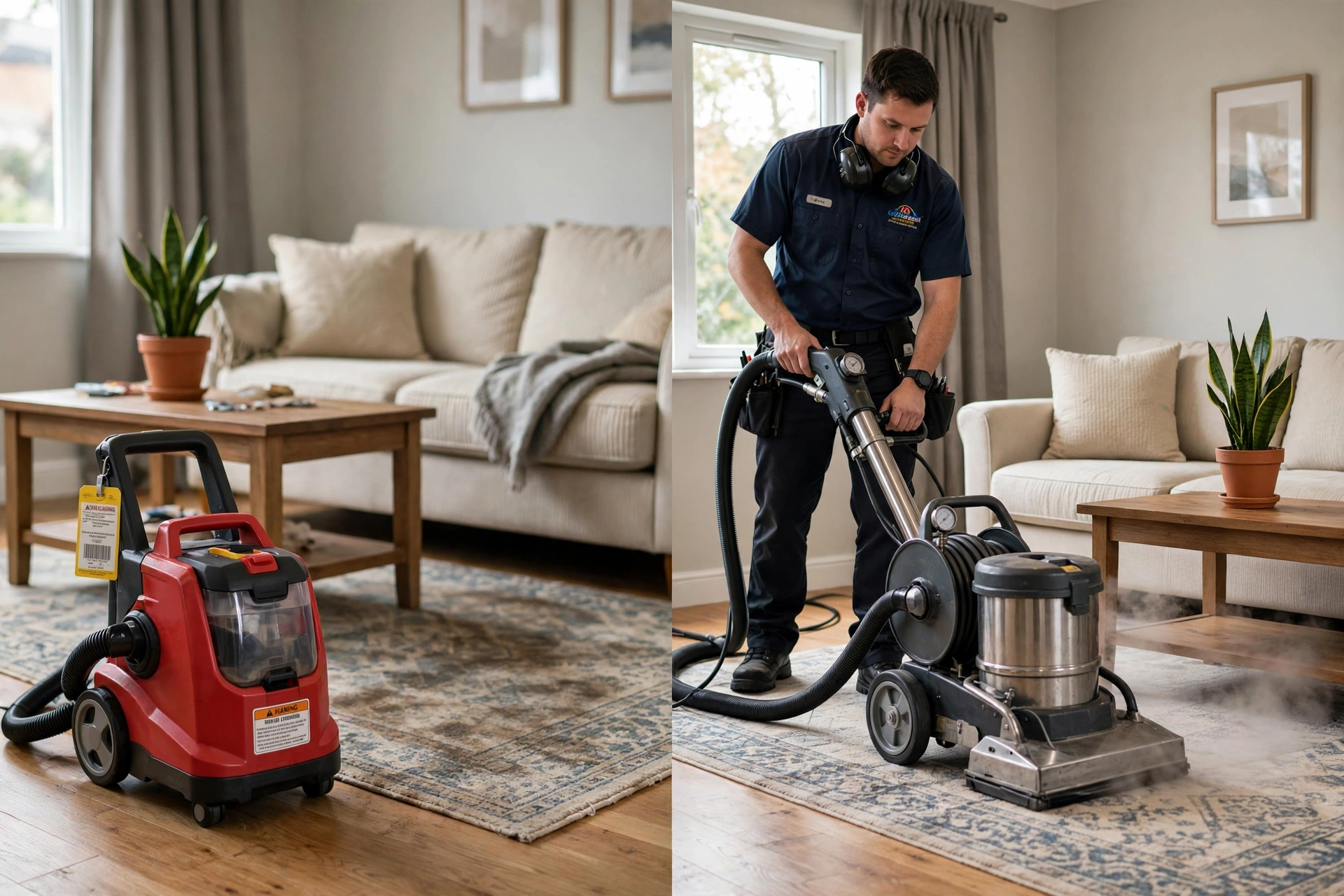
Rental machines are consumer-grade units built for portability and safety, not power. Industry comparisons put DIY machines at roughly 40 to 60 PSI of pump pressure, while professional truck-mounted systems run 400 to 1,000 PSI, up to 25 times more (Stain Kings, 2026). That pressure difference matters because it is what drives solution into the fibers and, more importantly, what pulls it back out.
Here is the practical consequence: rental machines extract roughly 60 to 70 percent of the moisture they put down, while professional systems extract 90 to 95 percent (Stain Kings, 2026). The rental leaves your carpet significantly wetter. That is not a minor detail. It is the single biggest difference between the two options, and it drives almost every other difference on this list.
Professional equipment also runs hotter. Truck-mounted systems maintain high water temperature throughout the job, and heat is a major factor in dissolving oily soils and killing dust mites. A rental machine starts with hot tap water and cools steadily as you work. By the second room, you are cleaning with lukewarm water and weaker suction, which is exactly when most people notice the results getting worse.
Drying Time: The Difference That Causes the Most Trouble
Because rentals leave more water behind, DIY-cleaned carpet stays damp much longer: typically 12 to 24 hours, and sometimes 24 to 48 hours in humid conditions (Elite Flooring Services, 2026; SA Carpet Cleaning, 2026). Professionally cleaned carpet usually dries in 4 to 8 hours, and with air movers, as little as 2 to 6 hours (Elite Flooring Services, 2026; Stain Kings, 2026).
Why does this matter so much? Because a carpet that stays wet for a full day is a biology experiment. Prolonged dampness invites musty odors, and in the worst cases, mold and mildew in the carpet backing and padding (SA Carpet Cleaning, 2026). This risk is not theoretical in Clarksville. Middle Tennessee summers are humid, and a soaked carpet drying in a closed-up house in July is exactly the scenario where things go wrong. If you DIY in the summer, you need airflow: open windows if the humidity allows, run ceiling fans, and consider renting or borrowing air movers.
There is a second drying problem specific to rentals: wicking. When a carpet is over-wet, deep soil dissolves and then migrates upward as the carpet slowly dries, leaving brown spots that were not there before cleaning. The carpet looks great on Saturday and spotty by Tuesday. Professional systems avoid this by extracting more water and drying faster, so the soil comes out in the machine instead of resurfacing later.
Cleaning Chemistry: Residue and Re-Soiling
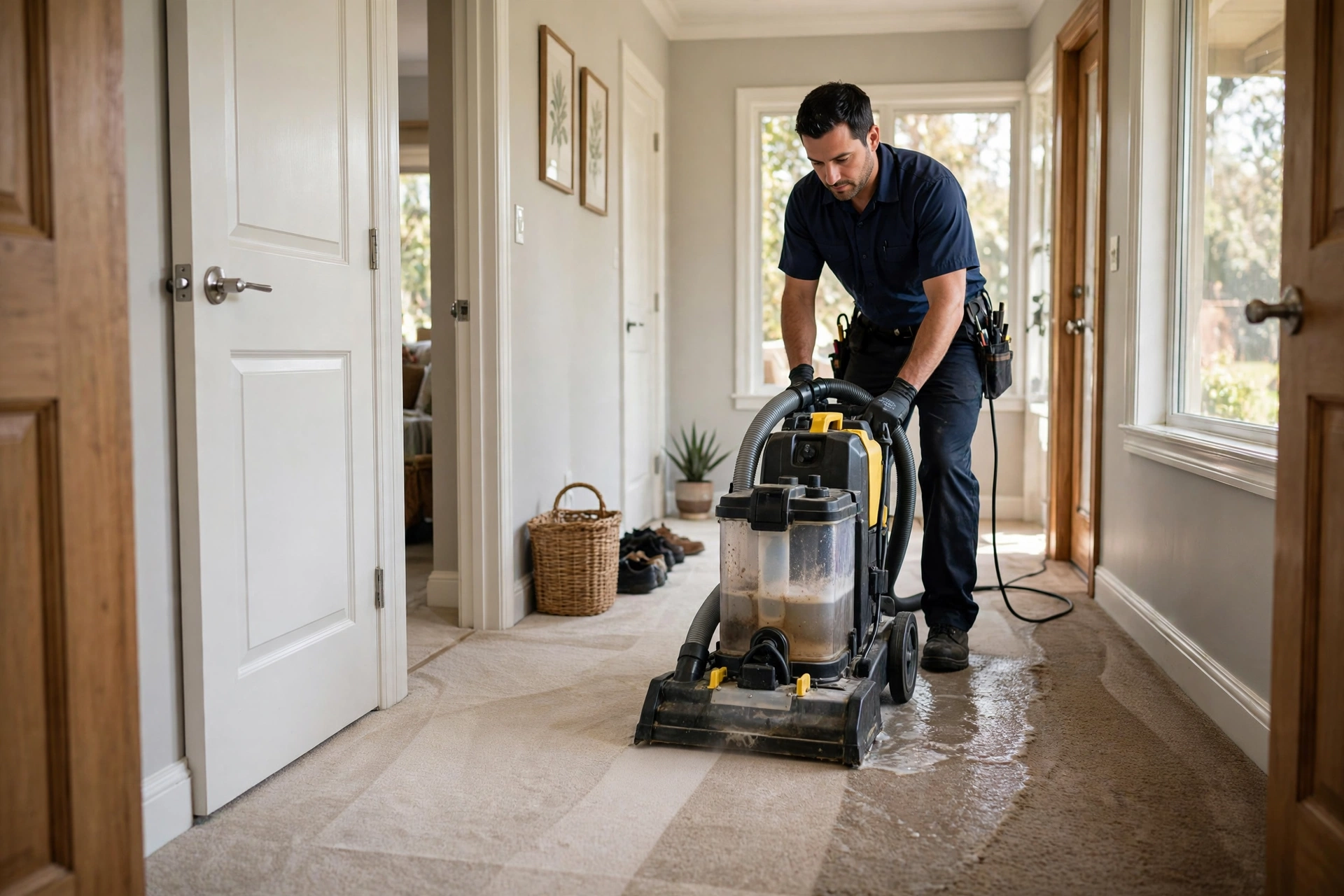
The solution matters as much as the machine. Rental machines use retail detergents, and the most common DIY mistake is using too much of it. More soap feels like more cleaning, but carpet chemistry works the opposite way: leftover detergent residue stays sticky in the fibers, and sticky fibers grab dirt. The result is a carpet that looks clean for a month and then re-soils faster than before, sometimes visibly worse along traffic lanes.
Professionals deal with this two ways. First, they dose correctly, which is harder than it sounds and comes from training. Second, many follow the cleaning with an acidic rinse that neutralizes alkaline detergent residue, which is a major reason professional results last 6 to 12 months while DIY results often visibly fade in 2 to 4 months (Stain Kings, 2026).
This is also where the vinegar myth needs addressing. Vinegar gets recommended online for everything, and it does neutralize mild odors. But vinegar does not break down oily soils, and it does nothing to the uric acid crystals in dried pet urine (Purge Bright, 2026). For pet problems specifically, you need enzyme cleaners designed for the job, which is covered in our stain troubleshooting guide and on our pet odor and stain removal page.
When DIY Actually Makes Sense
Here is the honest list. Renting a machine is a reasonable call when:
- Fresh, light spills: A spill from this morning on an otherwise clean carpet is a perfect DIY job. Speed matters more than equipment here.
- Between-cleaning refreshes: High-traffic lanes looking dull six months after a professional cleaning can be perked up with a careful rental pass.
- Move-out cleaning on a budget: If you are leaving a rental in Oak Grove or near Fort Campbell and the goal is satisfying a landlord rather than achieving perfection, a rental plus honest effort often does the job.
- Small areas: One bedroom or a small apartment is a manageable DIY project. A whole house is a different undertaking.
- You genuinely cannot afford a pro right now: A careful DIY clean beats no clean at all. Just understand the tradeoffs and do not over-wet.
The key word in all of these is maintenance or triage. DIY is good at maintaining a carpet that is fundamentally in decent shape. It is bad at rescuing a carpet that is not.
Real talk: If you are renting a machine because the carpet is truly trashed and you hope to save $150, you will probably spend the $60 on the rental, spend your whole Saturday, get mediocre results, and then call a professional anyway. That is the most expensive possible outcome: you paid twice and lost a weekend.
When DIY Does Not Make Sense
Some situations call for professional equipment and judgment, full stop:
- Pet urine beyond a fresh accident: Once urine reaches the padding, no rental machine on earth will fix it. It needs enzyme treatment and often pad-level work. Rentals tend to spread the contamination wider.
- Wool or delicate fibers: Wool can shrink, brown, or bleed under the wrong heat and chemistry. If you are not certain of your fiber type, do not experiment on it.
- Heavy, ground-in soil: Years of embedded dirt in traffic lanes need heat, pressure, and extraction power that rentals simply do not have.
- Carpet under warranty: Many carpet warranties require periodic professional cleaning, and some specify the method. Check your paperwork before you DIY; a rental receipt may not satisfy the warranty terms.
- Allergy or asthma households: If someone in the home has respiratory issues, the deeper allergen and dust mite removal of hot water extraction is worth paying for. The EPA notes that indoor air can be 2 to 5 times more polluted than outdoor air, and carpet is one of the reservoirs (Double Take Carpets, 2026).
- Large homes: A 2,000-square-foot house with a rental machine is a two-day project with degrading results as the machine tires and you tire faster.
The Hidden Costs of DIY
The rental receipt is not the whole bill. Add these up honestly:
- Your time: Professionals clean most homes in 1 to 3 hours. DIY takes 4 to 8 hours of active work, plus picking up and returning the machine (Elite Flooring Services, 2026). Some estimates put the full DIY project at 6 to 10 hours (SA Carpet Cleaning, 2026). Value your Saturday at whatever your overtime rate is and the math changes fast.
- Repeat rentals: Because DIY results fade in 2 to 4 months versus 6 to 12 for professional work (Stain Kings, 2026), you may rent three times as often to maintain the same appearance. Three $80 rental days is $240, which is more than one $182 professional visit at the national average.
- Damage risk: Over-wetting, shrinkage on natural fibers, color bleeding, and mold from slow drying are all real DIY risks. Any one of them costs more than the professional cleaning would have.
- Furniture moving: Pros move light furniture as part of the job. DIY means you are doing it all, twice.
What Professionals Actually Do Differently
It is not just a bigger machine. A proper professional visit follows a sequence that rentals skip entirely:
- Walkthrough and fiber identification: The technician looks at the carpet, identifies the fiber, notes problem areas, and sets expectations. If a stain is permanent, you hear it before anyone starts, not after you have paid.
- Dry soil removal: Thorough vacuuming with a commercial vacuum before any water touches the carpet. Most DIYers skip this, which means the first thing their rental does is turn dry dirt into mud.
- Pre-treatment: Traffic lanes and spots get pre-sprayed and given dwell time so the chemistry can work before extraction.
- Agitation: A counter-rotating brush or similar tool works the pre-spray into the pile. Rental machines combine all steps into one pass, which is why they underperform.
- Hot water extraction with proper chemistry: High heat, high pressure, correct detergent dose, and often an acidic rinse.
- Dry passes and airflow: Extra extraction-only passes, then air movers to accelerate drying.
None of these steps is magic. It is just a complete process versus a partial one. That is the real product you are buying.
The Cost Over Time: Annual Math
Let us run a five-year comparison for a typical Clarksville family home, using industry figures:
DIY route: Three rental days per year at $80 each (because results fade faster) equals $240 per year, or $1,200 over five years. That excludes your labor: roughly 6 hours per rental day, 18 hours a year, 90 hours over five years. It also excludes any damage incidents.
Professional route: One deep clean per year at the $182 national average equals $182 per year, or $910 over five years, with zero of your hours spent (Angi, 2026). Pet owners might do two visits a year, which is $364 annually, still competitive once you count DIY labor and repeat rentals.
Then there is carpet lifespan. Carpet costs $3 to $10 per square foot installed, so a 1,500-square-foot carpeted home represents a $4,500 to $15,000 investment (Answers by Expert, n.d.). Proper professional maintenance extends carpet life by years; inadequate cleaning shortens it. If professional cleaning delays a $7,000 replacement by even two years, it has paid for itself many times over.
Real talk: The rental machine companies are not ripping you off. Their machines do exactly what they are built to do: light maintenance cleaning. The problem is the mismatch between what people expect (professional results) and what the machine delivers (a surface refresh). Match the tool to the job and everyone is happy.
If You DIY, Do It Right
Decided to rent? Here is how to get the best possible result and avoid the classic mistakes:
- Vacuum thoroughly first, slowly, in multiple directions. This is the most-skipped and most-important step.
- Use less detergent than you think. Follow the dilution ratio exactly. More soap does not mean more clean; it means more residue.
- Do not over-wet. Make one wet pass followed by two or three dry (extraction-only) passes. If the carpet squishes underfoot, you used too much water.
- Work in small sections and finish each one before moving on, so no area sits soaking while you work elsewhere.
- Create airflow immediately. Fans on, windows open if humidity allows, air movers if you can get them. The goal is dry carpet in hours, not days.
- Stay off it until dry. Walking on damp carpet grinds dirt right back in and can leave footprints in the pile.
- Test spot removers first in a closet corner. This applies to rentals and pros alike: chemistry surprises are permanent.
The Middle Path Most People Overlook
Here is the option nobody advertises: do both. Use DIY for what it is good at and professionals for what they are good at. Vacuum weekly, blot spills immediately, run a rental over traffic lanes once or twice a year for maintenance, and book one professional deep clean annually. This is exactly what the Carpet and Rug Institute's care framework describes: regular vacuuming, quick spot cleaning, and professional deep cleaning every 12 to 18 months (Carpet and Rug Institute, n.d.).
This hybrid approach gives you the best of both worlds. The rental handles the visible surface soil between visits, which means the professional's annual visit goes faster and focuses on the deep embedded dirt instead of fighting through a year of neglect. Your total spend stays close to the DIY-only budget, but your results look like the professional-only budget. For busy Clarksville households, especially those with kids and pets, this is the most practical answer to the whole debate.
One caution on the hybrid: do not let the rental replace the professional visit. It is tempting to think that because you rented a machine in spring, you can skip the annual deep clean. The rental never reached the deep soil, the allergens, or the padding-level issues. It maintained the surface. The deep clean is still doing a different job.
A Clarksville-Specific Note
Two local factors should influence your decision. First, humidity. Clarksville summers are muggy, and muggy air slows drying dramatically. A DIY job in July without serious airflow is asking for musty odors. If you must DIY in summer, pick a breezy day, run every fan you own, and consider a low-moisture approach for maintenance.
Second, red clay and Fort Campbell dust. The soil around Montgomery County is clay-heavy, and clay tracks in as fine dust that works deep into carpet pile. It is exactly the kind of embedded soil that rentals struggle with and hot water extraction handles well. If your traffic lanes have that grayish cast that vacuuming does not fix, that is clay dust, and it is a sign the job has outgrown the rental.
Want It Done Right the First Time?
Free on-site walkthrough, written pricing before any work begins. Serving Clarksville and Montgomery County.
Call (931) 440-5353Frequently Asked Questions
How much does it cost to rent a carpet cleaner versus hiring a pro?
DIY rental runs $60 to $120 all-in for a day (machine, solution, supplies), while professional cleaning runs $120 to $350 for a typical home (SA Carpet Cleaning, 2026; Elite Flooring Services, 2026). The rental looks cheaper until you factor in your time, repeat rentals, and shorter-lasting results.
Can a rental machine get the same results as a professional?
No. Rental machines operate at a fraction of professional pressure and extract far less moisture (roughly 60 to 70 percent versus 90 to 95 percent), which means weaker deep cleaning and much longer dry times (Stain Kings, 2026). Rentals are fine for maintenance; they cannot match a true deep clean.
How long does carpet stay wet after DIY cleaning?
Typically 12 to 24 hours, sometimes up to 48 hours in humid conditions, versus 4 to 8 hours after professional cleaning (Elite Flooring Services, 2026; SA Carpet Cleaning, 2026). Extended dampness risks musty odors and, in bad cases, mold in the padding.
Is it bad to clean my own carpet too often?
Cleaning itself is not the problem; residue is. Frequent DIY cleaning with too much detergent leaves sticky residue that attracts dirt, so the carpet gets dirty faster. If you DIY often, use minimal detergent and consider a professional deep clean once a year to reset things.
Will a rental machine void my carpet warranty?
Possibly. Many carpet warranties require periodic professional cleaning, and some specify approved methods. Check your warranty paperwork before relying on rentals. When in doubt, a professional visit with a receipt is the safe choice.
What is the biggest mistake people make with rental machines?
Over-wetting. Too much water, too little extraction, and slow drying cause wicking (spots returning), musty smells, and in humid climates like Clarksville's, potential mold. One wet pass followed by multiple dry passes, plus aggressive airflow, prevents most of it.
References
Angi. (2026). Who should I hire to provide carpet cleaning services? https://www.angi.com/articles/who-to-hire-carpet-cleaning.htm
Answers by Expert. (n.d.). Carpet cleaning costs: Pro service vs renting a machine. https://answersbyexpert.com/m-auto/afs/default/rsoc/6430eeab-91ff-4c94-a634-7ef0ac52f782/carpet-cleaning-costs-pro-service-vs-renting-a-machine
Double Take Carpets. (2026). How often should you professionally clean your carpets? [Complete guide 2026]. https://dtcarpets.com/how-often-should-you-professionally-clean-your-carpets/
Elite Flooring Services. (2026). Carpet cleaning cost Haslet TX: Pricing guide. https://www.eliteflooringservicestx.com/post/carpet-cleaning-cost-haslet-tx
Happy Home Helpers. (n.d.). Professional vs. DIY carpet cleaning: Which is better? https://www.happyhomehelpers.com/professional-vs-diy-carpet-cleaning
Purge Bright. (2026). DIY vs professional carpet cleaning: What really changes the result? https://purgebright.co.uk/diy-vs-professional-carpet-cleaning/
SA Carpet Cleaning. (2026). Carpet cleaning cost in San Antonio 2026 complete guide. https://www.sacarpetcleaning.com/carpet-cleaning-cost-san-antonio-2026/
Stain Kings. (2026). Is professional carpet cleaning worth it? DIY vs pro cost comparison. https://stainkings.com/blog/is-professional-carpet-cleaning-worth-it/